What the calculation gives you
A snap fit joins two plastic parts with no fastener: a hook or a lip deflects during assembly and springs back behind an undercut. The calculation answers three questions. Will the material survive the deflection without yielding or cracking? How hard must the parts be pushed to assemble them? And how much force holds them together, or how hard is it to pull them apart? Each comes from the undercut depth, the geometry, the material's stress–strain curve and the angles of the lead-in and the retaining faces.
The allowable deflection
Plastics are designed by strain rather than stress, because their stress–strain curves are not linear and the allowable value depends on how often the joint is used. For a cantilever hook of length l and root thickness h, the deflection at the tip for a strain ε at the root is:
y = 0.67 ε l2 / h
uniform-section beam; a hook tapered to half the thickness at the tip allows about 1.6 times more for the same strain
The permissible strain for a joint used once is typically 2 to 4% for PA, PP and ABS, 4 to 6% for POM and PC; for repeated use take about 60% of that. For an annular snap fit (a lip around a cylinder) the strain at the undercut is simply the undercut depth over the diameter, ε = y / d, with the whole hub expanding elastically.
The deflection force
Cantilever: P = b h2 Es ε / (6 l)
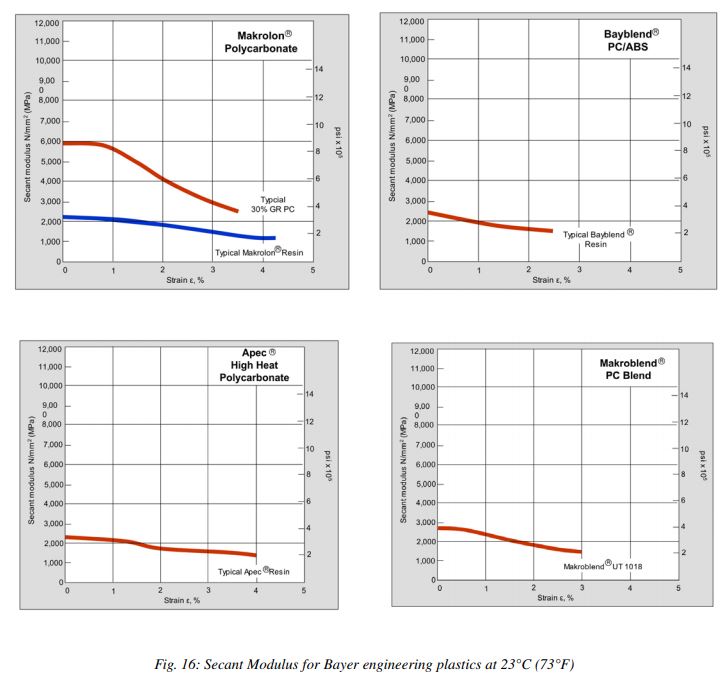
b width · Es secant modulus at the strain ε, read from the material curve, lower than the tangent modulus
Annular: P = y d Es X
y undercut · d diameter at the joint · X geometric factor from the ratio of outer to inner diameter and the wall, read from the standard chart for a rigid shaft in an elastic hub
The secant modulus is the point that catches people: at 2% strain it may be two thirds of the modulus on the data sheet, and the force is proportional to it.
Mating and release forces
The push-on force is the transverse force turned through the lead angle α with friction μ on the sliding face:
W = P (μ + tan α) / (1 − μ tan α)
α the angle of the face being pushed over, 15° to 30° for assembly · the same formula with the return angle α′ gives the pull-off force
The angles are the design levers. A shallow lead-in makes assembly easy; a steep return face (45° to 60°) makes release hard, and at 90° the joint cannot be released without breaking the hook. When μ tan α approaches 1 the joint is self-locking. Friction coefficients between plastics run from 0.2 to 0.6; the worksheet below uses 0.6 for ABS on ABS, which is why its forces are high.
Worked example
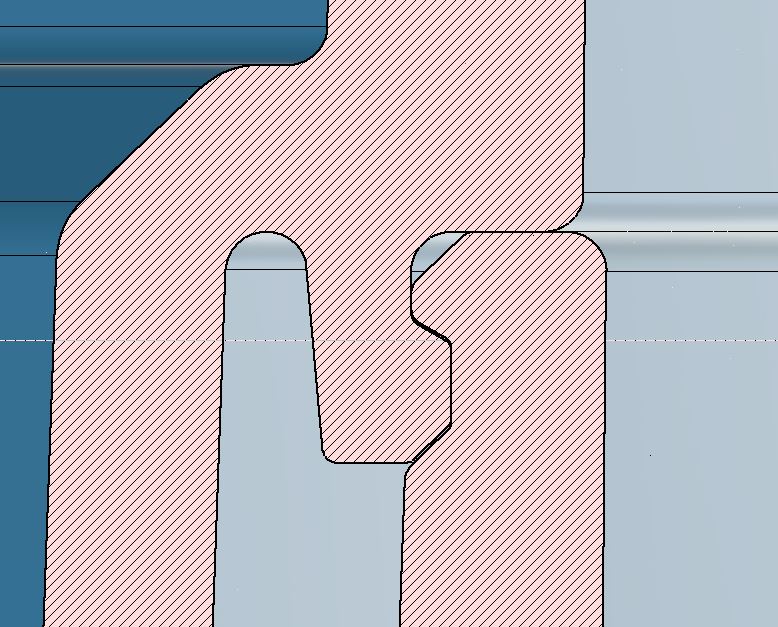
The worksheet below designs an annular snap joint that stacks filter canisters: easy to assemble, hard to take apart, no glue and no side-pull in the mould. From the joint diameter of 2.549 in and wall of 0.073 in it finds the diameter ratio and the geometric factor, sets the undercut, the 30° lead-in and the 60° return angle, and takes ABS with an allowable strain of 2% and its secant modulus. It defines the strain, the transverse force and the mating force as functions, solves for the undercut that reaches the allowable strain, and then gives the transverse, push-on and pull-off forces both for the current undercut and for the ideal one. Change the return angle or the friction coefficient and watch the pull-off force.
Common mistakes
- Data-sheet modulus instead of the secant modulus. It overstates the forces and the stress; at 3% strain the error is often 30 to 50%.
- Strain limit from the wrong material grade or use. Glass-filled grades allow a third of the strain of the unfilled resin; repeated assembly needs a lower limit again.
- Sharp root corner. A radius at the root of a cantilever hook of at least half the thickness halves the stress concentration; without it the hook fails at a strain well under the allowable.
- Hook treated as the whole flexibility. A hook on a thin wall deflects the wall too; the real deflection is larger and the force smaller than the cantilever formula gives.
- Friction guessed low. Plastic on plastic, dry, is 0.3 to 0.6 and depends on finish; it dominates the mating force with a shallow lead angle.
- Creep and temperature ignored. A joint under constant load relaxes; preload and retention fall over months, faster when warm.
Questions
- Cantilever or annular?
- Cantilever hooks are easier to mould and to tune; an annular lip is stronger and seals, but needs the hub to stretch all around and is hard to make releasable. The worksheet above is annular.
- How many assemblies can a snap fit take?
- Designed at 60% of the single-use strain, most unfilled thermoplastics take hundreds of cycles; the limit is usually wear of the lead-in face rather than the hook breaking.
- Does the mould direction matter?
- Yes. An undercut needs a side action or a lifter, or must be placed so the part can be stripped from the core; the geometry of the worksheet above was chosen to avoid a side pull.